

Atopic dermatitis mouse models
Pathology background and clinical context
Atopic dermatitis mouse models reproduce the skin inflammation and itch of atopic dermatitis, or atopic eczema, a chronic inflammatory skin disease with itchy lesions and rashes. The disease affects people of all ages but is most common in infants and children. Reported lifetime prevalence ranges between 10 % and 20 % in children and 1 % and 3 % in adults, and the chronic, relapsing course makes it a global public health concern.
Symptomatic treatment relies mainly on topical corticosteroids and immunosuppressors. Biologics against IL-4/IL-13 and the IL-31 receptor and oral JAK inhibitors are now used in moderate-to-severe disease (review, J Allergy Clin Immunol Pract 2023), and new candidates still need to be ranked in preclinical models before they reach the clinic.
Imavita runs three mouse models: an oxazolone-induced chronic model, an IL-23-induced model and an itching model. Each uses immunocompetent mice, and study design and statistical sizing are agreed before the first animal.
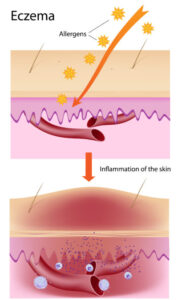
Atopic dermatitis mouse models overview
- Chronic, Th2-skewed hapten dermatitis: sensitisation, then repeated oxazolone challenges on the back and the ear.
- A 28-day format with ten challenges gives a wide back-skin window and cumulative clinical scores. A shorter 18-day format with five challenges is validated in house.
- Readouts include clinical scoring, back and ear thickness, histology, OCT, biomarkers and flow cytometry.
- Go to details on the oxazolone model
- Repeated intradermal injection of recombinant murine IL-23 into the ear of immunocompetent C57BL/6 mice.
- An 8-day format for fast screening and a 16-day format for chronic treatment, dose confirmation and benchmarking.
- Readouts include ear thickness by caliper, erythema and scaling, OCT, histology, qPCR and multiplexed ELISA.
- Go to details on the IL-23 model
- Itch induced alone, without dermatitis, with histamine, serotonin, SLIGRL peptide or substance P.
- Immunocompetent BALB/c and C57BL/6 mice.
- Scratching behaviour scored from video recording, in daylight or under infrared illumination for night recording.
- Go to details on the itching model
Choosing an atopic dermatitis mouse model
The three models answer different questions. The right choice depends on the mechanism and the timeline of your candidate.
| Feature | Oxazolone model | IL-23 model | Itching model |
|---|---|---|---|
| Induction | Sensitisation and repeated oxazolone challenges, topical on back and ear | Repeated intradermal rIL-23 injection in the ear | One pruritogen: histamine, serotonin, SLIGRL peptide or substance P |
| Immunological profile | Chronic, Th2-skewed, with a persistent Th1 component | IL-23 axis, which stimulates Th17 cells | Itch without dermatitis |
| Duration | 28 days (ten challenges) or 18 days (five challenges) | 8 days (screening) or 16 days (chronic) | Behavioural observation after induction |
| Lesion sites | Back skin and right ear | Ear | None, behaviour only |
| Typical group size | n = 8, sized on measured variance | 8 to 10 per group for a 25 to 30 % difference | Set at study design |
| Typical use | Potency and dose ranking, preventive dosing | First-intention screening, dose confirmation, benchmarking | Antipruritic activity |
| Reference compounds | Corticosteroid (betamethasone, clobetasol) or JAK inhibitor | Betamethasone (topical, PO or IP) | Set at study design |
Readouts and imaging
Endpoints are chosen for each model and can be combined in one study. Availability depends on the model, and the model pages give the detail.
- Clinical scoring of erythema, scaling and excoriations (equivalent to SCORAD), with instrumented erythema (SkinColor) and calibrated photography.
- Skin and ear thickness by caliper.
- In vivo imaging: optical coherence tomography (OCT) for epidermis and dermis thickness, and bioluminescence and fluorescence imaging.
- Histology (HES and IHC) with histomorphometry of epidermis thickness, dermal infiltrate and mast cells.
- Molecular readouts: qPCR on tissue extracts, multiplexed ELISA, plasma and skin biomarkers (IgE, IL-6, MMP-9) and flow cytometry panels.
- Itch: video-based behaviour scoring in the itching model. In oxazolone studies, scratching-bout counting is added as an option.
How a study runs
- Imavita handles the APAFIS regulatory submission, ethical review and reporting. Protocol setup and approval take 1 to 2 weeks.
- For the IL-23 model, the in vivo phase takes about 3 weeks (shorter with the 8-day scheme), followed by 1 week for results and 2 weeks for the draft report. Optional qPCR and multiplexed ELISA take 1 to 2 weeks each, and optional histology 6 to 7 weeks.
- An excipient control group is always included. Untested excipients are best avoided because they can cause false positive or false negative results, or local irritation.
- Formulation physico-chemistry (pH, osmolarity) should be known, and pharmacokinetics or transcutaneous passage data help set doses. Both are recommended, not required.
Frequently asked questions about atopic dermatitis mouse models
Which atopic dermatitis mouse model suits a first screen?
The 8-day IL-23 model is a fast, reproducible first-intention screen with anti-inflammatory reference drugs. The oxazolone model suits a chronic, Th2-skewed lesion and ranks potency over a wide window.
Can you measure itch?
Yes. The itching model scores scratching behaviour from video recording after a single pruritogen. In the oxazolone model, excoriation scoring measures skin damage, not pruritus, so scratching-bout counting is added when itch matters.
How many animals per group are needed?
In the IL-23 model, 8 to 10 mice per group generally detect a 25 to 30 % difference. In the oxazolone model, n = 8 is adequate for scaling, ear thickness and composite score, and n = 10 to 12 is advised to separate doses closer than two-fold.
Can you test topical formulations and other routes?
Yes. The IL-23 model accepts topical, oral, intraperitoneal, intravenous and subcutaneous routes with ready-to-use formulations, and formulation screening is available on request. The oxazolone model supports topical and systemic routes. An excipient control group is always included.
How well do mouse models predict human disease?
They are approximations. Global transcriptomic profiling shows major differences between human atopic dermatitis and murine models (Ewald et al., J Allergy Clin Immunol 2017;139:562-571). The model is therefore chosen for the mechanism being tested, and results are read as pharmacology in the mouse, not as a clinical prediction.
Contact us for more details or a quotation on atopic dermatitis mouse models.
