

Impact of Microbiota on Animal Models: From Facility Health Status to Translational Insights
Key point: The microbiological health status of an animal facility (conventional, SPF, SOPF, germ-free or gnotobiotic) changes immune, inflammatory and metabolic baselines. In Imavita’s hands, it measurably shifts disease severity in imiquimod psoriasis, collagen-induced arthritis and syngeneic tumour models. Sponsors should therefore treat housing status as a study variable that is defined, reported and controlled.
Understanding the Role of Microbiota in Research
The microbiota — the vast community of microorganisms living in and on animals — has emerged as a key determinant in the outcomes of preclinical studies.
Over the past decades, our understanding of how the microbial environment shapes physiology, immunity, and drug responses has dramatically evolved.
Today, the health and microbiological status of animal facilities play a central role in the reproducibility and interpretation of in vivo results.
A Short History of Animal Facility Health Status
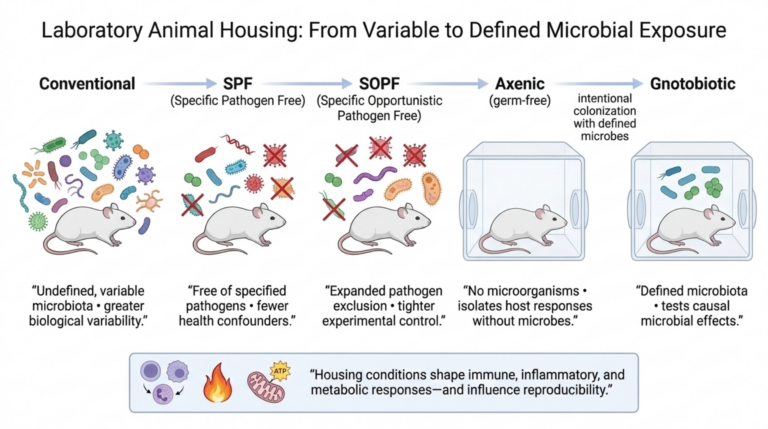
Laboratory animal housing conditions have progressed through several distinct stages:
Conventional facilities: Animals are exposed to undefined and variable microbial environments. While this setup reflects “real-world” diversity, it introduces biological variability and challenges reproducibility.
SPF (Specific Pathogen Free): Animals are free from specific known pathogens, allowing for more controlled studies with reduced health-related confounders.
SOPF (Strictly or Opportunistic Pathogen Free): Further refinement ensures animals are free from both specific and opportunistic pathogens, offering even more controlled immune and metabolic conditions.
Axenic (germ-free): Animals are completely devoid of any microorganisms, providing a unique model to study host-microbe interactions in isolation.
Gnotobiotic: Germ-free animals colonized with a defined microbiota, enabling researchers to explore the causal role of specific microbial communities in disease mechanisms.
These distinctions are more than technical details — they are critical parameters shaping immunological, inflammatory, and metabolic responses.
Microbiota-Dependent Phenotypes in Imavita’s Research
At Imavita, we have observed striking differences across models depending on microbiological status, underlining the microbiota’s impact on disease expression and therapeutic responses:
-
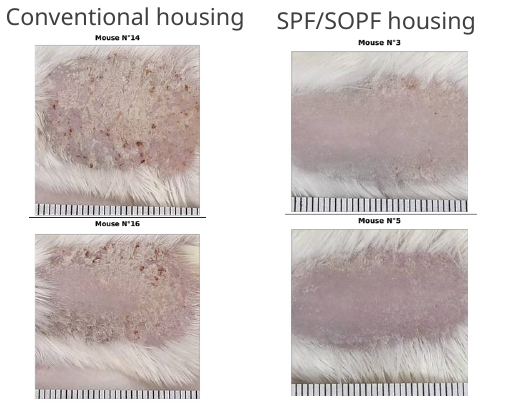
Psoriasis model: Animals housed in conventional conditions develop more severe skin lesions than those in SPF or SOPF zones, suggesting that microbial exposure amplifies inflammatory responses.
Collagen-Induced Arthritis (CIA) model: Disease severity is reduced in conventional animals, indicating that pathogen load and microbiota diversity modulate autoimmune joint inflammation.
Cancer models: Tumor-bearing animals show different responses to anti-cancer therapies depending on microbiological status. This aligns with the growing recognition that microbiota composition can influence drug metabolism and immune-mediated tumor control.
These findings emphasize that microbiota standardization is not only essential for reproducibility but also represents an opportunity to refine and personalize preclinical studies.
Applications and Perspectives
By carefully controlling and characterizing microbiota through the use of SPF, SOPF, germ-free, and gnotobiotic models, Imavita provides valuable insights into:
Host–microbe–drug interactions
Mechanisms of inflammation and immunity
Translation of preclinical results to clinical settings
As the field advances, microbiota profiling and management will become a cornerstone of translational pharmacology and disease modeling — improving both scientific rigor and predictive value.
At Imavita, our integrated expertise in animal models and microbiota management allows us to support partners in designing robust and translational preclinical studies.
Discover more on our services
FAQ zone
What is the difference between SPF and SOPF mice?
SPF (Specific Pathogen Free) mice are free of a defined list of pathogens, usually based on the FELASA monitoring panels. SOPF (Specific and Opportunistic Pathogen Free) mice are also free of opportunistic agents such as Pseudomonas aeruginosa or Staphylococcus aureus. The result is a narrower microbial background and fewer immune confounders.
Are germ-free and gnotobiotic mice the same?
No. Germ-free (axenic) mice carry no detectable microorganisms. Gnotobiotic mice are germ-free animals colonised with a known, defined set of microbes. Germ-free mice show whether microbiota is required for an effect; gnotobiotic mice show which microbes are responsible.
Why does facility health status change preclinical results?
The microbiota sets the baseline of the immune system: the Th17/Treg balance, myeloid cell activation and barrier function. It also contributes to drug metabolism. Changing the microbial environment can therefore shift disease severity, the size of a treatment effect and variability between animals, independently of the test compound.
Does microbiota affect the imiquimod psoriasis model?
Yes. Published work shows that skin and gut microbiota modulate IL-17/IL-23-driven inflammation after imiquimod application. At Imavita, mice housed in conventional conditions develop more severe lesions than SPF or SOPF mice. Housing status should therefore be fixed and reported when comparing studies.
Can gut microbiota change the response to cancer immunotherapy in mice?
Yes. Specific commensal bacteria have been shown to improve the efficacy of anti-PD-L1 and anti-CTLA-4 antibodies in syngeneic mouse models, and the same tumour line can respond differently depending on the animal vendor. Controlling the source of the animals and the barrier status is essential for consistent efficacy data.
How can microbiota-related variability be reduced in a study?
Source all animals from one vendor and one barrier zone, and allow enough acclimation time. Normalise microbiota between cages with bedding transfer or co-housing. Randomise treatment groups across cages and analyse the cage as the experimental unit. Faecal 16S profiling at baseline is an option when microbiota is a hypothesis of the study.
Should animal health status be reported in publications?
Yes. ARRIVE 2.0 recommends reporting the animals’ source and health or immune status, and the housing conditions. Stating the barrier status and the health-monitoring standard (e.g. FELASA) makes results easier to reproduce and to interpret across laboratories.
Do microbiota findings in mice translate to patients?
Only partly. Mouse and human gut microbiota differ in composition, and lab mice have immature immune experience compared with adult humans. Mouse microbiota studies are best used to generate mechanistic hypotheses and to make studies more robust. They are not a direct predictor of clinical microbiome effects.
